AI + Behavioural Science in Research Design
AI is no doubt valuable in the analysis stage of research projects…
…but it’s perhaps under-utilised in the DESIGN stage – especially when combined with BEHAVIOURAL SCIENCE.
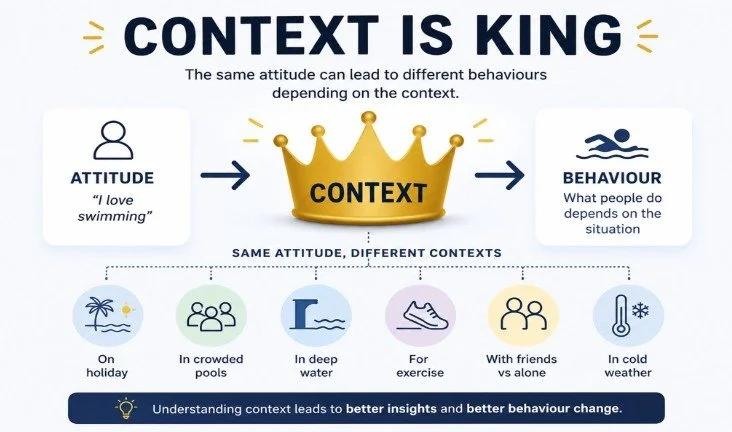
A well-known behavioural science saying is “context is king”.
But how often do we fully build this principle into research design?
AI can help researchers rapidly generate a wider range of discussion guide prompts or survey statements that intentionally embed context into the research.
For example, take the attitude statement:
“I love swimming”.
Interesting – but still very high level.
By designing around the idea that “context is king”, we can explore the RANGE OF SITUATIONS where this attitude IS (and ISN’T) true…
…and get much deeper under the surface.
For example, AI might suggest exploring:
Attitudes towards swimming when on holiday
Attitudes towards swimming in crowded pools
Attitudes towards swimming in deep water
Attitudes towards swimming with friends vs alone
Attitudes towards swimming for exercise vs recreation
Immediately, we move from a single broad attitude to a much richer understanding.
And that’s important because behaviour change rarely depends on attitudes in isolation – it depends on situations, environment and social context.
Used this way, AI becomes more than an analysis tool. It becomes a thought partner in designing smarter, more behaviourally informed research.
Has anyone else been using AI in research DESIGN as much as in analysis?